Thursday, January 30, 2014

NEED TO FOLLOW GANDHIAN PRINCIPLES IN RIGHT PERSPECTIVE

                                                                                        -MILAN K SINHA
mahatma gandhi
The day has again arrived for large section of political class to wear white khadi dress with a cap and   to rush to a Mahatma Gandhi statue, of course in a big vehicle to utter few parroted words with some crocodile tears in their eyes to show the onlookers, particularly media persons that they are the true believers, followers and torch bearer of Gandhian philosophy.

Unfortunately, day in and day out, the name of Gandhiji is being misused by those who proclaim from rooftop to be the sole political heir of this great soul about whom the Great Physicist and Nobel Prize Winner, Albert Einstein had said, ‘Generations to come, it may be, will scarcely believe that such a one as this ever in flesh and blood walked upon this earth.’ 

It has been fashionable in our country in majority of cases to resort to dharna and agitation in the name of Satyagraha- the most pious tool of protest, thereby putting the public at large to great inconvenience even in the national capital. It would be therefore, befitting if these set of protesters and the misusers of Gandhiji’s name, take some pain to read what Bapu wrote about ‘Satyagraha’ in Young India (20.10.1927) and Harijan (15.04.1933) 

‘Since Satyagraha is one of the most powerful methods of direct action, a Satyagrahi exhausts all other means before he resorts to Satyagraha. He will, therefore constantly and continually approach the constituted authority, he will appeal to public opinion, educate public opinion, state his case calmly and coolly before everybody who wants to listen to him, and only after he has exhausted all these avenues will he resort to Satyagraha. But when he has found the impelling call of the inner voice within him and launches out upon Satyagraha he has burnt his boats and there is no receding.’ ……’The word Satyagraha is often most loosely used and is made to cover veiled violence. But as the author of the word I may be allowed to say that it excludes every form of violence, veiled or unveiled, and whether in thought, word or deed. It is a breach of Satyagraha to wish ill to an opponent or to say a harsh word to him or of him with the intention of harming him…’ 

It is equally not out of context to take up briefly the concept of SWARAJ in the light of FDI controversy and other issues of governance in the country to know the gap between Gandhiji's thinking and  actual current happenings. In Gandhiji's concept of Swaraj, self-reliance, self-regulation and self -restraints are very important. He says," Real Swaraj will come not by the acquisition of authority by a few but the acquisition of the capacity by all to resist authority when it is abused. In other words, Swaraj is to be obtained by educating the masses to a sense of their capacity to regulate and control authority." He further says,"Swaraj means government by many. Where the many are immoral or selfish, their government can spell anarchy and nothing else."
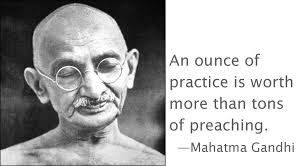

Undoubtedly, the life and work of the father of our nation would continue to be an eternal source of inspiration not only for all true Indians but also for million others world over in days to come. That’s why even the U.S President Barack Obama joins to say, ‘In my life, I have always looked to Mahatma Gandhi as an inspiration, because he embodies the kind of transformational change that can be made when ordinary people come together to do extra ordinary.’

As always, I am keen to know what you think on this subject. Hence, request you to post Comments to share your views and experiences.

                  Will meet again with Open Mind. All the Best.
# Published in Patna Daily.com
# Do visit my site : milanksinha.com  

Sunday, January 26, 2014

WHITHER PUBLIC ON REPUBLIC DAY?

                                                  - MILAN K SINHA


republic dayThe nation is celebrating the 64th anniversary of Republic Day amid so much of political chaos, particularly in nation’s capital, first because of unprecedented political demonstration and dharna by an elected chief minister along with his cabinet colleagues and supporters and also because of the rising political temperature in the wake of ensuing Lok Sabha election sometime before May, 2014 to pave the way for formation of a new government at the Centre.

It's a common knowledge that our Constitution was adopted by Constituent Assembly on 26 November, 1949 but actually came into effect on 26 January 1950 - the date of 26 January was chosen to commemorate the Purna Swaraj declaration of independence of 1930. Our Constitution, one of the finest in the world which was drafted by Constituent Assembly comprising of great legal luminaries and statesmen, declares India to be a sovereign, socialist, secular, democratic republic, assuring its citizens of justice, equality, and liberty, and endeavors to promote fraternity among them.

But, looking back to analyze what our forefathers had envisaged and dreamt and what we could achieve during the long years in the intervening period, no one would deny that the nation did progressed in many areas but    failed in greater proportions to address even the basic needs and requirements of common Indian (Aam Aadmi) - the issues of food, clothing, shelter, education, health, employment to name a few.

It is really shocking to note that even at this point of time every day 7000 people die of hunger in the country thereby being infamous for topping the list of countries in World Hunger Chart, one in every three malnourished children of the world live in India, the literacy percentage is still around 75% and most shamefully, about 60% people defecate in the open. Why?

Echoing the sentiments and aspirations of the large disadvantaged population which included millions of youths, both educated and uneducated, the President said in his address to the nation on this occasion, '"The aspirational young Indian will not forgive a betrayal of her future. Those in office must eliminate the trust deficit between them and the people. Those in politics should understand that every election comes with a warning sign: perform, or perish... Who wins the coming election is less important than the fact that whosoever wins must have an undiluted commitment to stability, honesty, and the development of India. We live in a turbulent part of the world where factors of instability have grown in the recent past...India has the intellectual prowess, the human resource and financial capital to shape a glorious future. We possess a dynamic civil society with an innovative mindset. Our people, whether in villages or cities, share a vibrant, unique consciousness and culture. Our finest assets are human...If Indians are enraged; it is because they are witnessing corruption and waste of national resources. If governments do not remove these flaws, voters will remove governments...Equally dangerous is the rise of hypocrisy in public life. Elections do not give any person the license to flirt with illusions. Those who seek the trust of voters must promise only what is possible...."

All said and  done,  can our  ruling  class  across  all political parties implement a common minimum agenda to fulfill the most basic aspirations of   common Indians of having a  safe, secured and normal  human  living  in consonance with the spirit of our constitution? 

                             Will meet again with Open Mind. All the Best.

# Published in Patna Daily.com on 26th Jan'14
# Do visit my site : milanksinha.com  

Thursday, January 9, 2014

HOLD YOUR HEART IN COLD

                                                                       - MILAN K SINHA
heart
India, you might know, is infamous for being the Heart Disease Capital of the world. On an average three million people die of heart disease annually in India. The situation is getting worse with every passing day despite known initiatives both by government machinery as well as by medical fraternity. 

Yes, there are many reasons for this problem, but one of the foremost reasons has been our poor lifestyle and also lack of basic awareness about this silent killer.

As per the latest medical research from the United Kingdom, even a 0.67 degree Celsius drop in temperature in winter season, as many as 200 more cases of heart attacks are reported in one day.

According to Life Science report, “Cold temperatures are known to raise blood pressure and also increase levels of certain proteins that could increase the risk of blood clots..."

It is worth mentioning here that winter is the most common season for heart attacks. Researchers have found that there are up to 53% more heart attacks in winter than in summer, twice as many heart attacks a day in January as compared to July.

In fact, when the temperature drops substantially in winter, our heart is required to work harder in order to maintain body temperature and health of arteries as during this season with tightening of arteries, blood flow is restricted and hence reduction in supply of blood to the heart. The combined effect of all these factors could trigger a heart attack.

During cold, those with heart disease are at special risk and so the elderly ones. As people get older, their ability to maintain normal body temperature goes down. Consequently, with dip in temperature in winter season, many a times suddenly, there is strong possibility of their falling prey to Hypothermia. Hypothermia denotes a condition wherein the body temperature falls below 95 degree Fahrenheit. The patient confronts this situation when the human body can't produce enough energy to keep it adequately warm. This can be fatal as it is found that heart failure causes most deaths in hypothermia.
 

It is a common knowledge that our best source of vitamin D is through our skin being exposed to sun. Now, in order to compensate for lack of sunlight, due to sedentary habits of relatively affluent urban population and corporate employees in India too, it is advised by medical practitioners to take vitamin D3 supplement as Vitamin D deficiency has been found to be associated with many ailments including arterial stiffness - a major risk factor for heart disease and stroke.

It being so, it is absolutely desirable to keep our body warm enough by wearing layers of clothing. It is interesting to know that air remains trapped between different layers of cloths thereby, forming a protective insulation. Protecting the head by putting on a hat, a monkey cap etc. also works well as it prevents loss of body temperature. Keeping hands and feet warm enough is advisable as heat is lost rapidly through these body parts. Physical activity which includes breathing exercise (Pranayam) and healthy eating are equally important during this period. 

Not to over emphasize, consulting your doctor immediately in any medical situation is always a must.

                           Will Meet Again With Open Mind. All the Best.
# Published in 'Health & Environment Times' in January'14
# Do visit my site : milanksinha.com  

Sunday, December 29, 2013

BORN DIFFERENT TO THINK AND ACT DIFFERENTLY

                                                                - MILAN K SINHA
mirrorWe are all born different. As we grow in life, we grow as different individuals with different thinking and taste. We act and react differently in different situations. We are in ourselves an example of unity in diversity. Friedrich Nietzsche puts it very nicely in these words, "At bottom every man knows well enough that he is a unique being, only once on this earth; and by no extraordinary chance will such a marvelously picturesque piece of diversity in unity as he is, ever be put together a second time."

We know and appreciate that each day is different from the other and that makes that day a new day with different prospects and possibilities for different persons. So, Paulo Coelho is right in saying, "You can become blind by seeing each day as a similar one. Each day is a different one; each day brings a miracle of its own. It's just a matter of paying attention to this miracle."

It being so, may I request you to stand before the mirror to see and ask yourself how and in what manner you are different from your closest friends? You would surely get answers to many of your questions. All the great persons, from Gautam Buddha to Socrates, Einstein to Raman, Mahatma Gandhi to Mother Teresa, Nelson Mandela to Barak Obama, Steve Jobs to Azim Premji, to name a few, who lived with us and who are still with us, have achieved those seemingly impossible feats by attempting their tasks differently.

Why to go far away, you just see around your own domain and you would find that the winner among you has been living his life differently. Please remember, you are a human being and not a machine. You are having your own laboratory inside you to experiment, create, innovate, improvise and in the process discover your true potential and enjoy life.

Before signing off tonight, let me share with you these thought provoking lines written by an unknown author: "We do not choose to be born. We do not choose our parents. We do not choose our historical epoch, the country of our birth, or the immediate circumstances of our upbringing. We do not, most of us, choose to die; nor do we choose the time and conditions of our death. But within this realm of choicelessness, we do choose how we live".

As always, I am keen to know what you think on this subject. Hence, request you to post Comments to share your views and experiences.

                  Will meet again with Open Mind. All the Best.

# Published in Patna Daily.com 
# Do visit my site : milanksinha.com  

Tuesday, December 17, 2013

WHO IS RESPONSIBLE FOR 'ATM' INCIDENTS ?

                                                                                   - MILAN K SINHA
In our country politics overtakes all other discussions less for good reasons, more for wrong ones. It is also happening with Bangalore ATM incident - a very sensitive public issue, a barbaric act beyond imagination.

In broad daylight a lady was attacked inside an ATM situated at the intersection of Bangalore's one of the busiest locations -the corporation circle. The dare devil act of the miscreant of pulling the shutter without bothering for attracting public attention and then assaulting the lady - a bank officer, to finally robbing the money by injuring her very seriously. The brave lady, who struggled with the robber, as shown in the footage of CCTV camera, is now struggling to get well in a private city hospital.

Naturally, it is pertinent to raise a few basic questions on behalf of the general ATM users. Why even in a metropolitan city like Bangalore, out of total ATMs numbering 2580, more than 600 ATMs didn't have security guards? Why, according to local police, in spite of repeated police call, banks failed to put in place even normal security measures to protect its customers visiting ATMs? What is the mechanism through which the local police take care of the security of branches and ATMs of banks at large? What is the responsibility of Reserve Bank of India (RBI) as controller of Banks in the country in this regard?

Surprisingly, neither the banks nor the RBI has anything specific to ensure security of ATM users. Painfully, the normal blame game and shifting of responsibility have set in. According to bank officials, ‘almost all facilities related to the ATM centre have been outsourced. The agency looks after the facilities provided at the ATM centre. The agency also looks after the installation and maintenance of the ATM machines. In nutshell, the functioning of ATM centres does not come under our purview.’ May be that's the reason one of the general managers of the Corporation Bank in whose ATM the lady bank officer was assaulted  said through a press release that taking care of ATM was the job of outsourced security agency. In fact, though very surprising, the Reserve Bank of India guidelines do not prescribe a mandatory security guard in ATMs. 

Then, whose responsibility is this? Or, nobody can be held responsible at least as per law, for this state of affairs. 

Interestingly, National Payments Corporation of India (NPCI) which is the umbrella organization of all retail payment systems including ATM in India and is set up by the banks with the support and guidance from Indian Banks’ Association (IBA)has its ‘Vision’ of providing ‘Anywhere, Anytime Payment Services, Simple & Easy to Use, Safe & Secured, Fast & Cost Effective’. If that is so, millions of ATM users in the country deserve a point wise reply to such issues which don’t match with NPCI’s vision document in reality.

Now, see the other side of ATM story. Based on NPCI data, the number of ATMs in the country — of public, private,  foreign and cooperative banks, part of the National Financial Switch (NFS) connecting all ATMs — has crossed 1.25 lac mark, majority of which have been installed in metropolitan and urban areas. Not only this, notwithstanding the ground reality about the security and other operational issues confronting the management of existing ATMs, the union government has directed public sector banks to have on site ATMs at all their branches as part of government’s financial inclusion drive. It may be recalled that finance minister while delivering his budget speech in Feb’13 had said that PSU banks assured him that all their branches would have an ATM in place by the end of current financial year. To say in plain words, the gap of 34668 ATM is to be bridged by March end as at the end of March'13, these banks had a combined strength of 72,340 branches, of which only 37,672 branches had onsite ATMs. 

So, as the things stand, PSU banks are to run against time to install more than 20000 ATMs in residual four months of this fiscal as despite clear directive by ministry and RBI, the state run banks are running behind schedule on this count. 

Be as it may, the primary responsibility, by any scale of measurement and judgement, of protecting the interest including safety and security of customers within its premises rests on the shoulder of the banks. They have outsourced this whole process of installation, its operation and maintenance to other agencies based on their business plan and operational convenience. As such, the banks are squarely responsible and accountable for any lapse in rendering safe and secured banking services to its customers who reposed confidence in them by establishing a business relationship under the extant banking norms and regulations.

Undoubtedly, RBI, as the apex bank of the country has a definite role to play not only to monitor the security and safety related aspects of ATMs but also to ensure justification of the tall promise of anytime-anywhere banking. It is because there has been gradual increase in complaints related to non- functional ATMs, failed transactions, ATM frauds to name a few. RBI on its part, must also look into the fact that despite its clean note policy, how even ATMs are dispensing unclean notes as a matter of routine.

Local police must keep a serious watch on ATMs and branches of banks during their routine patrolling and also arrange to have regular security review meeting with all concerned in order help prevent recurrence of  such horrific incidents in future.

As always, I am keen to know what you think on this subject. Hence, request you to post Comments to share your views and experiences.

                Will meet again with Open Mind. All the Best.
# Do visit my site : milanksinha.com  

Saturday, December 7, 2013

NELSON MANDELA - THE REAL HERO AND STATESMAN

                                                                        -MILAN K SINHA
nelson mandela


Nelson Mandela, the icon of South Africa’s anti-apartheid struggle and a colossus of 20th century public service is no more. Mandela died at home in Johannesburg at the age of 95 after spending months fighting his illness.


In a nationwide televised address, the South Africa’s President said, "Fellow South Africans, our beloved Nelson Mandela, the founding president of our democratic nation, has departed…. Although we knew this day was going to come, nothing can diminish our sense of a profound and enduring loss. His tireless struggle for freedom earned him the respect of the world…."

"Nelson Mandela was a giant for justice and a down-to-earth human inspiration. He showed what is possible for our world and within each one of us if we believe, dream and work together for justice and humanity,’ Ban Ki Moon, UN Secretary-General said. In his condolence message the Indian Prime Minister, Manmohan Singh told, ‘A giant among men has passed away. This is as much India's loss as South Africa's. He was a true Gandhian. His life and work will remain a source of eternal inspiration for generations to come. I join all those who are praying for his soul.’

In fact, Mandela rose from rural obscurity to challenge the might of white minority apartheid government of South Africa. Mandela was born on 18 July 1918 in the village of Mvezo in Umtatu of Cape province. His father, Gadla Henry Mphakanyiswa, was the chief councillor to the monarch. The name of his mother was Nosekeni Fanny.

On one occasion in 1994, Mandela, whose forename was Rolihlahla, candidly admitted,” No one in my family had ever attended school. On the first day of school my teacher, Miss Mdingane, gave each of us an English name. This was the custom among Africans in those days and was undoubtedly due to the British bias of our education. That day, Miss Mdingane told me that my new name was Nelson. Why this particular name, I have no idea."

Instead of serving the monarch following his father, Mandela chose to fight against white domination. He studied at Fort Hare University, an elite black college, but left in 1940 without completing his studies and involved himself with the youth league of African National Congress (ANC) with Tambo and Sisulu.

His struggle against apartheid was untiring and completely focused. He organized mass boycotts, particularly against the laws supporting racial discrimination and oppression. The historic statement of Mandela during the course of his 1964 sabotage trial revealed his firm resolve towards his mission. "During my lifetime I have dedicated myself to this struggle of the African people," Mandela said. "I have fought against white domination, and I have fought against black domination. I have cherished the ideal of a democratic and free society in which all persons live together in harmony and with equal opportunities. It is an ideal which I hope to live for and to achieve. But if needs be, it is an ideal for which I am prepared to die."

Twenty three years ago when he was released on February 11, 1990 after 27 years of detention for opposing the then white-minority apartheid regime of South Africa, he wrote on that day, “As I finally walked through those gates ... I felt even at the age of 71 that my life was beginning anew. My 10,000 days of imprisonment were at last over."

Really so. Series of talks and negotiations began in 1991 between the African National Congress and the government, which finally led to South Africa's first all-race elections on April 27, 1994. As a natural outcome of the said election, Nelson Mandela was chosen as the first black President of South Africa. It was really a defining moment of the 20th century. Nevertheless, his task as president was immense and extremely challenging, nothing less than preventing a civil war.

Mandela made reconciliation the theme of his presidency. “We enter into a covenant that we shall build a society in which all South Africans, both black and white, will be able to walk tall, without any fear in their hearts, assured of their inalienable right to human dignity—a ‘Rainbow Nation’ at peace with itself and the world,” he declared on being sworn in.

Undoubtedly, the hallmark of Mandela's mission was the Truth and Reconciliation Commission which investigated apartheid crimes on both sides and tried to heal the wounds of all.

In 1999, Mandela handed over power to younger leaders and engaged himself in another activity of human welfare - fighting South Africa's AIDS crisis. In early 2005 when Mandela lost his only surviving son to the disease, his fight against AIDS became more intense and personal.

Mandela and President FW de Klerk were jointly awarded the Nobel Peace Prize in 1993. He was the Second non-citizen and non-Indian recipient of India’s highest civilian award, Bharat Ratna in 1990.

Truly speaking, Nelson Mandela’s long walk from an apartheid prisoner to South African President to a loving father of all south Africans, black and white alike, who tried his best to remake the country based on equity and justice for all through democratic process has been matchless and hugely inspiring.

As always, I am keen to know what you think on this subject. Hence, request you to post Comments to share your views and experiences.

                Will meet again with Open Mind. All the Best.

# Published in Patna Daily.com on 6th Dec'2013
# Do visit my site : milanksinha.com  

Tuesday, December 3, 2013

DR. RAJENDRA PRASAD – A SIMPLE MAN, A BRILLIANT SCHOLAR AND A GREAT STATESMAN

                                                                                             - MILAN K SINHA
rajendra pd

The country of 1250 million Indians has only one Desh Ratna and he is no other than the first President of India Dr. Rajendra Prasad who was also conferred Bharat Ratna in 1962.

On this day, 3rd December, Rajendra Prasad was born 130 years ago in a village named Jiradei in erstwhile Saran district of Bihar. His father Mahadev Sahai, a scholar of Sanskrit and Persian sent the five year old Rajendra to an accomplished Muslim scholar to study mathematics along with Hindi and Persian languages. Prasad’s mother, Kamleshwari Devi, was a religious woman who used to tell him inspirational stories.

He joined the prestigious Presidency College, Calcutta, in the year 1902 and graduated with first division. He completed his masters in Economics with first division from Calcutta University in 1907. He was a very simple and brilliant student for whom the examiner wrote in his college answer paper, 'Examinee is Better than Examiner'.

After a short stint in teaching profession, Rajendra Prasad went again to Calcutta to study law and completed his Master of Law in 1915. He started practicing law in Patna High Court in the year 1916 and soon became a leading lawyer having roaring practice.

Although Prasad had many family liabilities to take care of, he joined Mahatma Gandhi’s Champaran Satyagrah Movement wholeheartedly without bothering for financial loss and then never looked back. His courage, conviction and dedication to the cause of freedom struggle was so profound that he asked his son to drop out of his school soon after Gandhiji’s call to boycott government educational institutions as part of non-cooperation movement of 1920.


However, in order to take care of the studies of such drop out students, Rajendra Prasad enrolled his son too, in Bihar Vidyapeeth, an educational institution established by Maulana Majharul Haque in 1921 based on our own tradition and culture. In 1921, Rajendra Babu also joined Haque very actively by residing in Bihar Vidyapeeth campus in a thatched-roof house and conducting all freedom struggle activities for 25 long years till 1946.

He was a one of the closest associate of Bapu. He became the President of Indian National Congress in 1934 Mumbai convention. On second occasion, he became Congress President in 1939 after the resignation of Netaji Subhash Chandra Bose. He again took over as Congress chief in November 1947.

Rajendra Babu was elected the President of Constituent Assembly on December,1947 and when on 26th January,1950 the constitution of independent India was finally accepted and ratified, he became the acting President of India to be finally elected in May 1952 to hold the office of President which he graced till 1962 - the end of his second term.

After relinquishing office of the President of India on 13th May, 1962, Dr. Rajendra Prasad, returned to Patna and started living in the same small and simple house like a common man, later to move in another small house constructed at the initiative of another great son of mother India, Loknayak Jai Prakash Narayan in the same campus of Bihar Vidyapeeth. He breathed his last there only after a few months on 28th February, 1963.

Dr. Rajendra Prasad was very simple and down to earth person. All through his life he believed in and accordingly practised the principle of 'simple living and high thinking. He was a true Gandhian, a brilliant scholar, and a great statesman who lived like a common man and fought for the welfare of common man.

As always, I am keen to know what you think on this subject. Hence, request you to post Comments to share your views and experiences.

            Will  meet again with Open Mind. All the Best.

# Published in Patna Daily.com on 3rd Dec,2013
# Do visit my site : milanksinha.com